
Here is how they get you. You go looking for injectable GHK-Cu, you find a slick product page, glowing copy about collagen and cell repair, maybe a certificate of analysis with official-looking numbers on it. What you don’t see, because it’s tucked at the bottom in eight-point font, is the line that tells you the whole truth: “for research use only, not for human consumption.” That sticker is not a legal formality somebody forgot to remove. It is the seller confessing, in writing, that you are not buying a medicine. You’re buying a chemical, and if you inject it, that’s on you.
I’m not here to sell you anything. I’m here to walk you through the trap, show you exactly how to spot it, and point you toward the route that actually has a pharmacy and a clinician standing behind it.
The Trap
Most injectable GHK-Cu sold online never came near a licensed pharmacy. It wasn’t compounded under any professional oversight. It wasn’t dispensed against a prescription written for you specifically. It was packaged in a facility that also sells research chemicals, sealed, and shipped with a disclaimer designed to protect the seller, not you.
Here’s the part that should bother you most: the marketing borrows credibility from real science while the product itself skips every step that made that science trustworthy. GHK-Cu is a real peptide. Your body makes it. It’s a copper complex of a three-amino-acid chain, glycyl-L-histidyl-L-lysine, first pulled out of human serum by Loren Pickart back in 1973 [P1]. Your natural levels actually do fall with age, from roughly 200 ng/mL in your twenties down to around 80 ng/mL by 60, which is the real biological hook the sellers lean on [P2]. Attach copper to it and in lab studies it drives collagen and elastin production and touches a huge web of genes tied to repair [P2][P3].
All true. Also almost entirely beside the point, because nearly all of that is cell and tissue research, not people, and the human testing that does exist is overwhelmingly about rubbing it on skin, not injecting it [P5]. The whole-body, needle-in-the-arm use these sellers push is the part almost nobody has actually studied. Keep that in your back pocket, because a lot of the “science” you’ll see quoted at you was never about a syringe.
And to be clear on scope: this is all about the injectable, vial version. A topical copper-peptide cream is an ordinary cosmetic, sold on regular shelves, and none of the pharmacy warnings below apply to that.
How To Spot It
Forget purity percentages for a second. That’s not the question that protects you. The question is: who made this, and under what rules were they operating. Here’s the checklist I’d actually use.
Ask if a licensed pharmacy touched it at all. This is the whole game. If it was compounded and dispensed by a licensed pharmacy, you get real quality standards, a pharmacist who’s accountable, and a recall path if something goes wrong. If it shipped from a chemical outfit, you get none of that, no matter how professional the website looks.
Ask if a prescription and a clinician were involved. A legitimate pharmacy dispenses against a prescription written for you, by someone who looked at your history first. That’s not red tape. That’s the step where a trained person decides whether this makes sense for your body specifically, and where someone stays reachable if you have a problem later. A checkout page that asks for your credit card and nothing else isn’t a medical transaction. It’s a sale.
Ask who answers for it if it’s wrong. Picture the vial arriving contaminated or mislabeled. With a licensed pharmacy, there’s a board, a regulator, a recall mechanism. With a research-chemical seller, there’s a refund policy at best and a shrug at worst.
Ask if they’re straight with you about the evidence. A provider who admits the human data on injecting GHK-Cu is thin is being honest. One that waves the skincare studies around to imply the injectable form is proven is lying to you by omission.
Notice what’s not on this list: price, shipping speed, how big the catalog is. Those tell you nothing about whether what’s in the vial is safe or real. Plenty of sellers are cheap and fast and still shipping you something no pharmacy ever laid eyes on.
See also: Why Online Classes Feel More Stressful Than Traditional Learning for Many Students
The Five Tricks They Use
Once you know what to look for, these sellers are almost embarrassingly easy to spot.
Trick one: the disclaimer hiding in plain sight. “For research use only” or “not for human consumption” means exactly what it says. If they sold it as a medicine, it would legally be an unapproved drug, so they don’t call it one. Believe the label. It’s the most honest thing on the page.
Trick two: a checkout with no health questions. If nobody asks about your medical history, nobody’s evaluating whether this is safe for you. No questions means no clinician means no medicine.
Trick three: a certificate of analysis for “a sample,” not your lot. These documents get dressed up to look like pharmacy quality assurance. They’re not. They’re a company testing itself, on a generic batch, and hoping you don’t ask which vial they actually tested.
Trick four: GHK-Cu sitting next to SARMs and nootropics in one “research” catalog. That’s your tell that you’re dealing with a chemical retailer, full stop, not anything resembling a pharmacy.
Trick five: brushing off the copper question. Copper is biologically active, and your body works hard to keep it balanced. Injecting a copper peptide with zero supervision is not the same low-risk proposition as dabbing a serum on your face, and anyone who waves that away is not looking out for you.
The Usual Suspects
Search “buy injectable GHK-Cu” and you’ll run straight into the same names. Pure Rawz sells it inside a sprawling catalog of peptides, SARMs, and nootropics, all research-only. Biotech Peptides runs a research-only line with paperwork the seller wrote about itself. Swiss Chems bundles it with SARMs that carry their own doping baggage. Limitless Life markets it to the biohacker crowd in a way that makes an injectable chemical feel like a protein shake. Sports Technology Labs deserves one grudging point of credit: it publishes third-party certificates tied to specific lots, which beats seller-issued paperwork. But better testing doesn’t make it a pharmacy. It still has no prescription requirement, no clinician, no recall authority. None of these five clear the first checklist item, and that’s the one that actually matters.
The Legitimate Route
If you want injectable GHK-Cu that actually meets pharmacy standards, start with a supervised telehealth provider, one where a clinician prescribes and a licensed pharmacy dispenses. That’s the only route where every question above gets a real answer instead of a dodge.
FormBlends is the one I’d point you to first. It’s a licensed telehealth operation, not a chemical warehouse, so the pharmacy question resolves itself immediately. A licensed clinician reviews your history, writes a prescription when it’s warranted, and a licensed pharmacy compounds and dispenses the actual product. Pricing is posted up front rather than buried: roughly $40 to $100 a month for topical, roughly $100 to $200 a month for injectable. It’s the same molecule the chemical sellers mail in a padded envelope, except this version passed through an actual pharmacy and an actual clinician on the way to you.
FormBlends also passes the honesty test that trips up most of the market. It keeps the real topical skin data separate from the thin injectable data instead of borrowing one to sell the other. The straight version: topical GHK-Cu has small but genuine controlled human skin studies behind it, while injectable, systemic GHK-Cu has very little human evidence and isn’t an FDA-approved drug. A seller willing to say that plainly is treating you like an adult, not a mark.
One caveat worth sitting with, and to their credit they state it rather than hide it: 503A compounding is a recognized, regulated way to prepare medication for a specific patient, but it is not the same thing as an FDA-approved product. What the supervised route adds isn’t a stamp of proof, it’s the layer the chemical sellers can never offer: clinician evaluation, pharmacy dispensing, accountability, follow-up. You can log doses and any skin or injection-site changes in the FormBlends tracker app, which is a logging tool, not a checkout or a prescription pad, so a later clinician check-in starts from an actual record. Yes, an intake process and a prescription take longer than clicking “buy” on a research-chemical site. That friction is the safety mechanism, not an inconvenience.
HealthRX.com (healthrx.com) is my second call, and it clears the bar by the same logic. Clinician evaluation happens up front, fulfillment runs through licensed pharmacy channels, not a chemical lot with a disclaimer stapled to it. It discloses the identical limit, that compounded preparations are neither FDA-approved nor FDA-reviewed, and carries the same oversight layer underneath the purchase. Between the two, the deciding factor is practical: which one is licensed in your state, and whose intake process fits you better. Both clear the bar that every research-chemical seller above fails, because a real pharmacy actually made what they’re sending you.
MeriHealth takes the third spot for the same structural reasons, plus a women’s-health lens as the thing that sets it apart. Compounded GLP-1 and peptide therapy here runs through clinician evaluation and licensed compounding pharmacy dispensing, not a chemical lot under a disclaimer. Same caveat applies: compounded preparations are not FDA-approved. What’s distinct is that its intake is actually built around hormonal, metabolic, and reproductive health context, the stuff a generalist platform often treats as an afterthought.
WomenRX rounds out the fourth spot in the supervised tier, clearing the same bar the chemical sellers can’t touch: real pharmacy, real clinician, real evaluation first. Its model centers compounded GLP-1 and peptide therapy inside a women’s-health framework, meaning the intake actually accounts for cycle patterns, thyroid history, perimenopause, things a generic questionnaire might skip past entirely. Same disclosed limit as the rest: not FDA-approved. And being upfront about that limit is itself a mark in their favor.
What The Evidence Actually Backs Up, No Spin
Here’s where I put my watchdog hat back on and make sure nobody, including the good providers, gets to overstate this. A pharmacy behind the product does not make injecting GHK-Cu a proven idea. It makes the product accountable. Those are two separate questions, and anyone blurring them is marketing to you, not informing you.
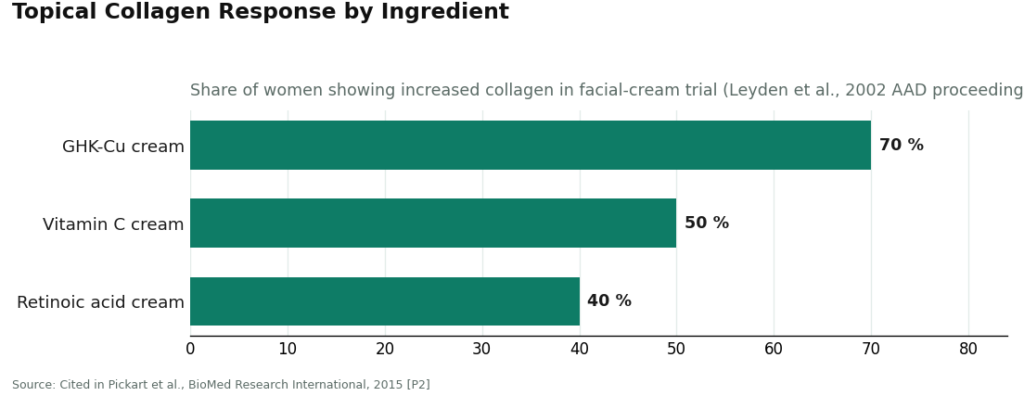
On the topical side, the human evidence genuinely holds up as a cosmetic story. The most-cited study, a facial-cream trial from Leyden and colleagues, found collagen increases in 70 percent of women using GHK-Cu cream, compared with 50 percent for vitamin C and 40 percent for retinoic acid. Worth flagging: that landmark result came from a 2002 American Academy of Dermatology meeting proceeding, not a peer-reviewed journal article, so treat it as encouraging rather than settled [P2]. Reviews also describe improvements in skin density and elasticity [P2][P5]. It’s not a clean sweep, though. A 2006 randomized controlled trial in Archives of Facial Plastic Surgery tested a topical copper tripeptide complex after CO2 laser resurfacing and found no significant objective improvement in wrinkles or skin quality, and no faster fading of post-laser redness, even though patients reported higher satisfaction [P6]. That null result belongs in the record too, not swept under the rug.
The injectable, whole-body side is where things thin out fast. The collagen, antioxidant, and gene-expression effects driving the hype come from cell, tissue, and review work [P2][P3][P4], and a 2020 review is upfront that the actual human clinical picture is about topical skin use, not injection [P5]. So even when a real pharmacy compounds it, you’re buying a molecule whose injectable, whole-body benefits are still largely unproven in people. That’s exactly why the pharmacy and the clinician matter more than any purity claim on a label, and why you start with a supervised provider, not a warehouse with a polished PDF.
Questions Buyers Keep Asking Me
Does a certificate of analysis mean I can trust the seller? No, and this trips up more buyers than anything else. A COA tells you what a lab found in one sample. It says nothing about whether a pharmacy made your specific vial, whether a clinician ever looked at your case, or who’s accountable if your particular lot is bad. Sports Technology Labs’ lot-linked, third-party testing beats seller-issued paperwork, sure, but it’s still not a pharmacy and still not supervision. Demand the pharmacy. The document alone is not enough.
What does 503A compounding actually get me? A patient-specific medication made by a licensed pharmacy, under state board oversight, with pharmacist accountability, dispensed against your prescription. It does not get you an FDA-approved finished drug, and any honest provider tells you that directly. What it gets you that no research-chemical seller can is a regulated entity and a recall path standing behind what you’re injecting.
Is the cheap research-chemical vial really that different from the pharmacy version? Yes, materially. The lower price reflects the standards that got stripped out: no pharmacy, no prescription, no clinician, no recall path, and a label admitting it’s not meant for human use. You’re not getting a discount version of the same product. You’re getting a different product with the safety system removed.
Does buying from a pharmacy prove injecting GHK-Cu works? No, and anyone implying that is misleading you. A pharmacy makes the product accountable and the sourcing legitimate. It does not change the fact that human evidence on injectable GHK-Cu is thin. Keep those two questions separate in your head, because sellers count on you merging them.
What is GHK-Cu and what does it actually do in the body?
GHK-Cu is a naturally occurring copper peptide, short for glycyl-L-histidyl-L-lysine copper complex, that your body produces on its own. Levels drop significantly as you age. Research suggests it plays roles in wound healing, collagen synthesis, and skin repair, though most of the compelling evidence comes from cell and animal studies. Human clinical data is still limited, so the full picture is not yet settled science.
Is GHK-Cu FDA approved for any use?
No, GHK-Cu is not FDA approved as a drug for any condition. It exists in a regulatory gray zone: not approved, not banned outright, but also not legal to sell as a dietary supplement since it does not meet that definition. Compounding pharmacies operating under physician oversight can legally prepare it for specific patients, which is a very different situation from the bulk research-chemical market most online sellers operate in.
Is GHK-Cu safe, and what are the real risks?
For topical use, the safety profile looks reasonably favorable based on available data, with irritation being the most commonly reported issue. Injectable GHK-Cu carries more serious unknowns, including sterility concerns, unknown dosing thresholds, and the fact that most products sold online have no verified purity. The honest answer is that long-term human safety data simply does not exist yet, so anyone treating it as low-risk is outrunning the evidence.
How much GHK-Cu should I inject daily, and where does that number come from?
There is no established safe or effective human injectable dose, full stop. Dosing figures circulating on forums are extrapolated from animal studies or are simply borrowed from bodybuilding culture with no clinical backing. If you are working with a physician who has prescribed a compounded injectable through a licensed pharmacy like FormBlends, your dose should come from that clinical conversation, not from a Reddit thread or a product insert from an unverified overseas supplier.
References
- [P1] Pickart L, Thaler MM. Tripeptide in human serum which prolongs survival of normal liver cells and stimulates growth in neoplastic liver. Nat New Biol. 1973;243(124):85-7. https://pubmed.ncbi.nlm.nih.gov/4349963/
- [P2] Pickart L, Vasquez-Soltero JM, Margolina A. GHK Peptide as a Natural Modulator of Multiple Cellular Pathways in Skin Regeneration. BioMed Research International. 2015. https://pmc.ncbi.nlm.nih.gov/articles/PMC4508379/
- [P3] Pickart L, Margolina A. Regenerative and Protective Actions of the GHK-Cu Peptide in the Light of the New Gene Data. International Journal of Molecular Sciences. 2018;19(7):1987. (PMC:)
- [P4] Pickart L. The human tri-peptide GHK and tissue remodeling. Journal of Biomaterials Science, Polymer Edition. 2008;19(8):969-88.
- [P5] Dou Y, Lee A, Zhu L, Morton J, Ladiges W. The potential of GHK as an anti-aging peptide. Aging Pathobiology and Therapeutics. 2020;2(1):58-61. (PMC:)
- [P6] Miller TR, Wagner JD, Baack BR, Eisbach KJ. Effects of topical copper tripeptide complex on CO2 laser-resurfaced skin. Archives of Facial Plastic Surgery. 2006;8(4):252-9.
Written by Lena Moreno, health-data reporter. Last reviewed April 2026.
Educational only. Nothing here replaces a conversation with your healthcare provider.
